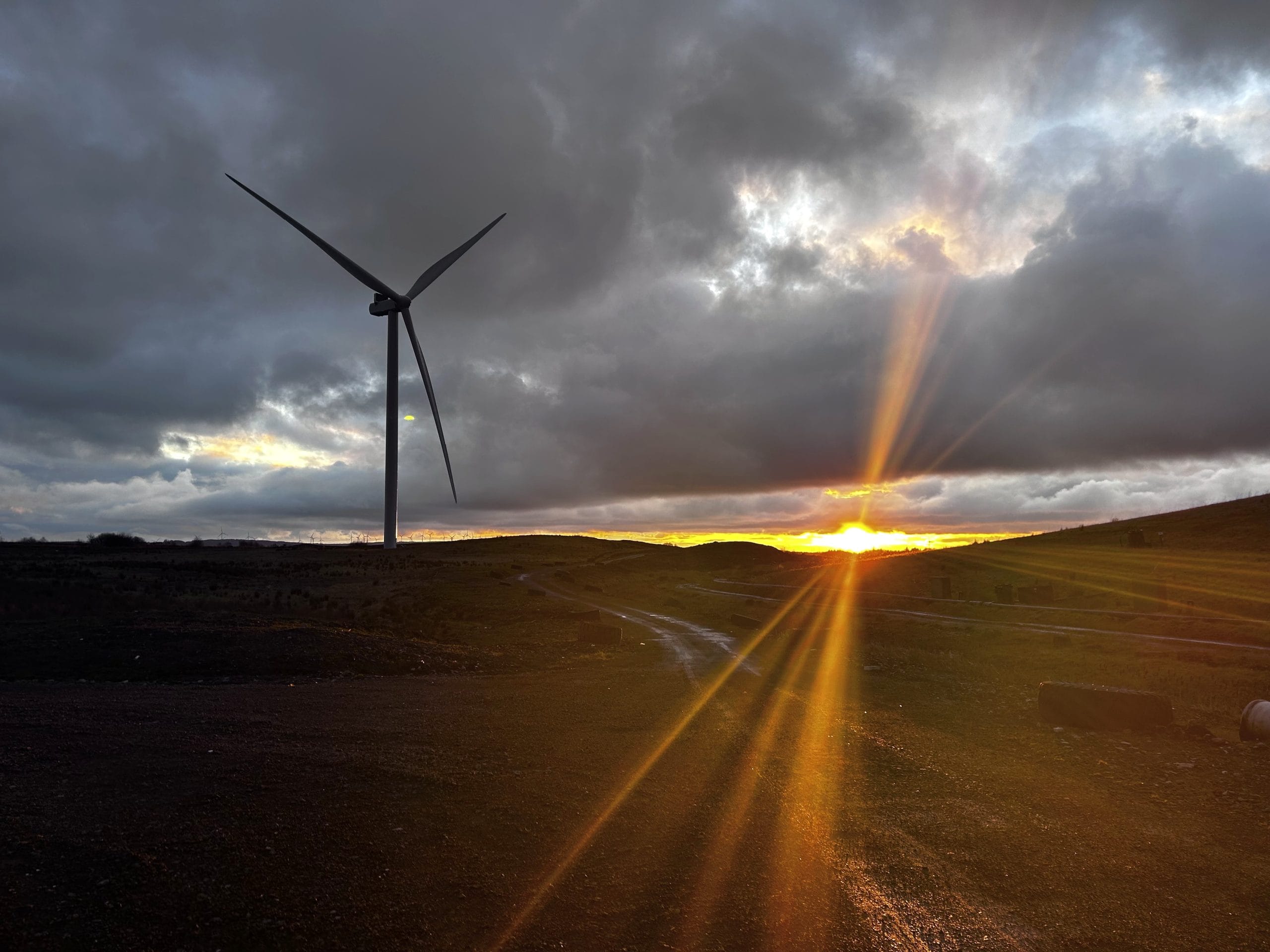
Transforming Brownfield Land into a Clean Energy Source
Forty-five gigawatt hours. That’s the amount of low-cost, low-carbon electricity being generated every year by one of CleanEarth Energy’s most complex wind projects, Rigmuir Windfarm in South Lanarkshire.
CleanEarth conceived of, secured through planning, built, and energised this windfarm on a former landfill site just outside East Kilbride. The brownfield site is now home to three 150m wind turbines, each sporting 68-metre blades. Negotiating the city streets of East Kilbride – and its numerous roundabouts – required the use of specialist haulage equipment and a great deal of forward planning.
Through the innovative use of a blade lifter, drivers were able to tilt blades at angles up to 60-degrees – clearing pinch-points and obstructions along the route. And by travelling in the early hours, the CleanEarth team ensured that disruption to local traffic was kept to a minimum.
Massive carbon savings aiding Net Zero goals
The entire process, from commencement of the delivery programme to energisation, took just three months. The completed Rigmuir Windfarm has been generating 45 GWh annually since energisation in 2024 – sufficient energy to power 34,000 homes. In doing so, this generation saves 9,500 tonnes of carbon emissions annually – over a quarter of a million tonnes of CO2 during the project’s lifetime.
The onshore wind ‘ban’ in England was lifted mere days into the new Labour leadership. With this, came a new onshore wind taskforce, including members like the UK’s renewable trade association RenewableUK. Rigmuir Windfarm stood at the start of a new journey for wind power in the United Kingdom – at this crucial time in the UK’s journey to net zero, Rigmuir Windfarm plays a significant part in the UK’s ongoing efforts to decarbonise the grid in line with 2030 goals. And it has since been joined by the completion of a new CleanEarth Energy windfarm, Tacher Windfarm, generating an annual 39,000,00kWh of clean energy for seeing yearly carbon reductions of 288,000 tonnes.